
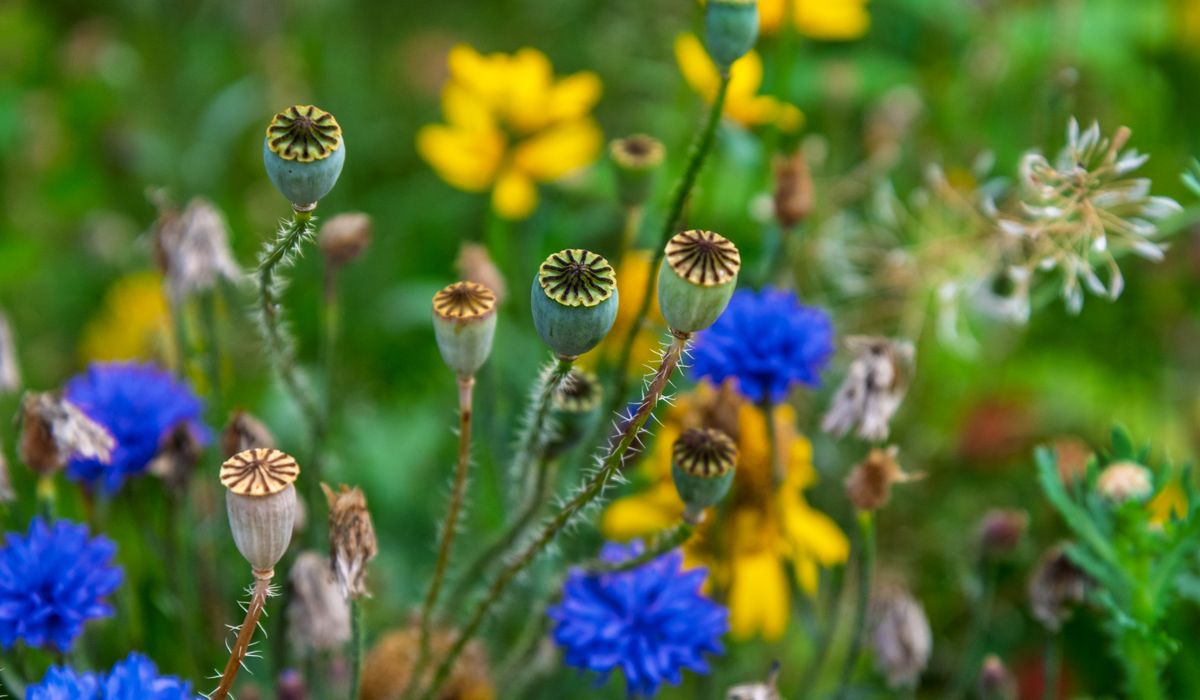
Spotting Common Wildflowers on a Summer Walk
Reading a Summer Meadow
Between late May and the middle of August, a decent British meadow turns into a shifting list of names. You do not need to know them all. Learn three well — ox-eye daisy, red clover and yellow rattle — and you will have a working key to almost every unimproved grassland you walk through, from a Dorset downland to a council verge in Sheffield.
The trick is to identify by three things at once: leaf shape, flower form and habitat. Naming a plant from the flower alone is guesswork. Naming it from the flower plus the leaves plus the ground it is standing on is diagnosis.
Ox-eye Daisy: The Meadow's Brightest Marker
Ox-eye daisy (Leucanthemum vulgare) is the flower that makes people stop and reach for a camera. Each bloom is a single white daisy head, 4–6cm across, with a flat yellow centre and narrow white rays, carried on a wiry stem that generally reaches 30–60cm. In a hay meadow in June they arrive in drifts.
When the flower is obvious, look down. The lower leaves are spoon-shaped — wider at the tip than the base — on short stalks, with lobed or toothed edges. Leaves higher up the stem are narrower, stalkless and toothed, and they sit opposite each other. That combination of a big plain daisy with spoon-shaped basal leaves is very reliable.
Two confusion species are worth ruling out. Scentless mayweed and corn chamomile both have feathery, finely divided leaves, nothing like a spoon. The ox-eye's leaves are solid blades. If in doubt, rub a leaf: ox-eye has no strong scent.
Habitat is a strong clue too. Ox-eye daisy is a classic indicator of unimproved grassland: old hay meadows, downland, churchyards, railway embankments and those wide rural verges that only get cut once in late summer.
Red Clover: Leaves That Tell You First
Red clover (Trifolium pratense) is often in flower before you notice the flower at all, because the leaves are so distinctive. Each leaf is divided into three oval leaflets, and each leaflet carries a pale crescent or V-shaped watermark across its middle. Look at the base of the leaf stalk, where it meets the stem, and you will find papery stipules veined with pink or purple — a detail worth learning, as it separates red clover from its relatives at a glance.
The flower head is a rounded cluster, roughly 2–3cm wide, of rose-pink to deep magenta tubular florets. It sits directly on top of the stem rather than on a long stalk. Flowering runs from May right through to October in a good year, peaking in June and July.
White clover is the common mix-up, but it creeps along the ground, its flower heads are smaller and white, and its watermarks are fainter. Red clover stands upright and its colour is unmistakable at ten paces.
You will find it in hay meadows, rough grass, verges, field margins and old leys. As a legume it fixes nitrogen, and its deep florets are built for long-tongued bumblebees — watch a patch for two minutes and you will usually see one working it.
Yellow Rattle: The Quiet Engine of the Meadow
Yellow rattle (Rhinanthus minor) is the plant that makes wildflower meadows possible, and it is worth learning for that reason alone. It is a semi-parasite on grasses, tapping into grass roots and drawing off water and nutrients. That weakens the grasses and opens up space for everything else. Where yellow rattle thrives, diversity follows.
The flower is a yellow, two-lipped tube with a hooded upper lip, arranged in a loose spike. The real giveaway sits just behind each flower: prominent dark teeth on the bracts, like a tiny saw edge. The leaves are opposite, lance-shaped and coarsely toothed, a slightly grey-green.
Come back in late July or August and the seed capsules will have dried. Shake one gently and the loose seeds rattle inside — that sound is the name, and it is the easiest confirmation you will ever get from a plant.
Look for it in traditional hay meadows, chalk downland and restored meadows. Its needs are simple: a site that is allowed to set seed before the cut.
Habitat Clues: What the Ground Tells You
Once you can read three plants, you can read a whole field. Use these as a quick field guide to the ground beneath your feet.
- Unimproved grassland: ox-eye daisy, yellow rattle, red clover, plus common knapweed, meadow buttercup, bird's-foot trefoil and cowslip. Species-rich and usually old.
- Improved or nutrient-rich ground: perennial ryegrass, white clover, docks, nettles and creeping thistle. Fertile, but flower-poor.
- Management clues: a verge left uncut until late July or August is being managed for wildlife. A verge mown short in May is not.
Timing matters as much as place. Hay meadows peak in the last week of June and the first fortnight of July; after that the cut comes and the show is over until next year.
Six Things to Take and Look For
- Walk in mid-morning on a warm, still day, when flowers are fully open and insects are active.
- Carry a x10 hand lens for stipules, bracts and seed capsules — the details that settle an identification.
- Look at the base of the plant, not just the flower. Basal leaves are often the most diagnostic.
- Note the habitat as you record the plant. Flower, leaf and ground together make a reliable record.
- Photograph the whole plant, then the flower head, then a single leaf. Three frames, no guesswork later.
- Stay on the path, take nothing, and follow the Countryside Code — these meadows are fragile, and some sites are legally protected.
Start with these three species and let the list grow. By August you will be naming half a meadow without breaking stride, and the walk will never feel quite the same again.
tag: Wildflowers

Eleanor Bramley Author
This semi-parasitic annual reduces vigorous grasses, making room for delicate wildflowers in a new meadow. Sow it fresh in autumn.
YOU MAY ALSO LIKE
Growing Yellow Rattle to Weaken Grass
Sep 6
10Wait for dry seed heads, collect on a sunny afternoon, and store in paper bags away from damp.
read more
Collecting and Storing Wildflower Seed Safely
Sep 1
10Crested dogstail, sweet vernal grass, and meadow foxtail offer structure and food for insects without dominating a small plot.
read moreMeadow Making
-

ERRIC CATONA
Snowdrops, snakeshead fritillary, and wild garlic bring life to damp corners before trees fully leaf in spring each year.
May 19, 2016 at 5.12 pm
Reply
ERRIC CATONA
Mix field scabious, betony, and wild marjoram with traditional cottage flowers for a relaxed, pollinator-friendly border in any garden.
May 19, 2016 at 5.12 pm
Reply -
ERRIC CATONA
As growth begins, check for bare patches, remove early weeds by hand, and avoid feeding the soil with fertiliser.
May 19, 2016 at 5.12 pm
Reply
Wildflowers
Your email address will not be published.